Designing Analog IC · Lesson 1
Analog vs Digital: Why Every Chip Still Needs Analog Circuits
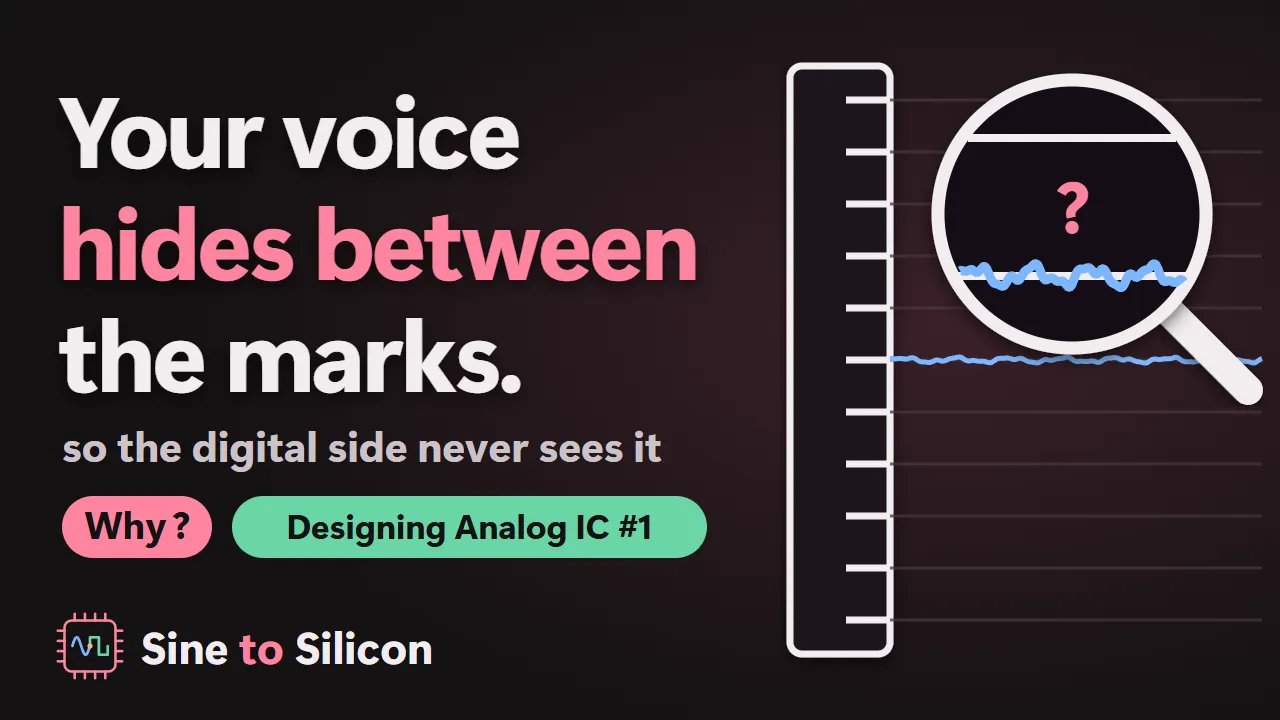
Why a chip that does billions of sums a second still cannot hear your voice on its own, explained with a ruler.
Press play: it starts at
Chapters13 parts, tap one to jump there
In one sentence
Digital in the middle, analog at both edges.
Watch first, then read. The video shows every idea moving. These notes write out each step so you can check the maths at your own pace. Press any ▶ time button to jump the video to that moment.
The chip in your phone can do billions of sums every second. And yet it cannot hear your voice, not on its own. Your voice reaches it as a wiggle of voltage about a hundredth of a volt tall, far too small for it to read well. So a tiny analog circuit has to rescue it first. Designing circuits like that, on a chip, is what this course is about.
All you need is school maths and basic electricity: what a volt is. This lesson shows exactly why your voice needs rescuing, with nothing more than a ruler.
Analog and digital, with a ruler
Start with a pencil. It has a true length: maybe 13.27 centimetres, maybe any length at all, with no gaps in between. A smooth amount like that, which can take any value, is called analog.
Now measure it with a ruler that only has a mark at every centimetre. You read the nearest mark, 13, and write down the number. A reading rounded to the nearest mark, and kept as a number, is called digital.
Notice what got lost: the 0.27. A ruler only sees as finely as its marks; anything between two marks is gone.
Most of the real world is analog. Sound, light, warmth, your heartbeat: they all change smoothly. Nature does not hand out numbers, and your ears do not take them.
Why chips insist on numbers
So why do chips insist on numbers? Because a number is tough. Inside a chip it is stored as bits, ones and zeros: a high voltage or a low voltage. A little electrical fuzz changes nothing, because high is still high.
An analog voltage has no such protection. Every value counts, so the same fuzz lands right on top of your signal, and it stays there.
A bit: high or low
The fuzz changes nothing. High is still high.
An analog voltage
Every value counts, so the fuzz stays on the signal.
That is why numbers can be stored, copied perfectly and sent around the world. So somewhere between the smooth world and the chip, something has to measure it with a ruler.
Your voice as a voltage
Sound is air being squeezed and stretched, back and forth. A microphone turns that into a voltage that wiggles in the same pattern: louder sound, taller wiggle.
Speak close to a phone and that wiggle is about 10 millivolts tall, from its lowest point to its highest. Milli means a thousandth, so 10 millivolts (10 mV) is a hundredth of a volt.
The part that turns this voltage into numbers is called a converter. Engineers call it an ADC, an analog-to-digital converter. It does not watch all the time: thousands of times a second it takes a reading and writes down the nearest mark.
So a digital signal only exists at separate moments, and only at set values. An analog signal exists at every moment and can take any value. In a circuit, that smooth amount is usually a voltage, a current or a charge.
How a sound becomes a list of numbers is the whole story of lesson 1 of DSP from Scratch. Here we only need the ruler.
Hiding between the marks
Give our converter a simple ruler: it measures from 0 to 1 volt, with a mark every tenth of a volt. That is 100 mV between marks.
- The length of the ruler is called the range: here, 1 V.
- How fine its marks are is called the resolution: here, a mark every 100 mV.
Our voice wiggle sits in the middle, around half a volt, and it is 10 mV tall. That is a tenth of the gap between two marks. So what does the converter write down? Half a volt. Half a volt. Half a volt. Your whole sentence becomes the same number over and over. Your voice is right there, but the ruler cannot see it.
Real converters have far more marks than ten. Every extra bit doubles them:
So it is never quite this bad. But the idea is exactly the same: the less of the ruler your wiggle covers, the fewer marks it crosses, and the less of your voice survives.
The rescue: an amplifier
Before the converter, we make the wiggle bigger. A circuit that does that is called an amplifier, and how many times bigger it makes the wiggle is called its gain:
- Gain 10: 10 mV in, 100 mV out. Now the wiggle is as tall as one gap, and it just starts to tick across a mark.
- Gain 50: 10 mV in, 500 mV out, half a volt tall. Now it crosses five gaps, and the readings rise and fall with your voice. It was there all along; it just had to be bigger than the marks.
Too much gain: clipping
So why not turn the gain all the way up? Try 200: 10 mV in, 2 V out. But the ruler only goes from 0 to 1. Everything above 1 V reads 1; everything below 0 reads 0. The tops and bottoms of your voice get sliced flat. That is called clipping: the crunchy, broken sound you hear when someone shouts straight into a microphone.
Gain 1
Every reading is 0.5 V. The voice hides between the marks.
Gain 10
100 mV tall: one gap. Only its very peaks could reach a mark.
Gain 50
500 mV tall: five gaps. The readings follow the voice.
Gain 200
2 V tall on a 1 V ruler: the tops and bottoms are sliced flat.
So the gain has to be just right: big enough to cross many marks, small enough to stay on the ruler.
100. The wiggle must grow to the length of the ruler:
At gain 100 the wiggle fills the ruler exactly, from 0 to 1. But a designer would not pick 100: a shout is much taller than a hello, and it would clip. So they leave room above and below, maybe with a gain of 50. Picking a number like that, for a reason you can say out loud, is what circuit design is.
The way back to sound
Now follow your call to the other phone. Its chip receives the numbers and has to turn them back into sound.
- A second converter works the ruler in reverse: it reads each number and puts out that voltage. Engineers call it a DAC, a digital-to-analog converter.
- But a speaker needs a strong push to move the air, much more current than the converter can give. So one more amplifier gives the signal muscle, and the speaker plays your voice.
Now look at the whole trip:
Analog at the edges of every chip
It is not just phones. A smartwatch shines a light into your wrist. Each heartbeat changes how much light comes back, by a tiny amount, and that tiny change takes the same trip: amplify it, then convert it.
Any chip that listens to the real world, or talks back to it, needs analog circuits at its edges. They sit on the same chip as the digital part, built from the same tiny parts: transistors.
Three common mistakes
Recap
- The real world is analog: smooth amounts, at every moment.
- Chips work with numbers: readings taken at separate moments and rounded to the marks of a ruler. The ruler’s length is its range; how fine its marks are is its resolution; every extra bit doubles the marks.
- A tiny voice wiggle hides between the marks, so an amplifier makes it bigger first. Its gain must be just right: too little and the voice hides; too much and it clips.
- On the way back, a converter and another amplifier turn numbers into sound.
Say the main idea aloud once: digital in the middle, analog at both edges.
Next, lesson 2 opens up the part every one of these circuits is built from, the transistor, and shows it works a lot like a water tap.
Interactive lab
Size the wiggle to the ruler
Turn the amplifier’s gain until a voice fills the converter’s ruler without falling off its ends. Try a finer ruler, a louder voice, and listen to what the chip actually receives.
Sign in to open the lab
It is free. Signing in with Google also keeps your progress and your scores.
Sign in with GoogleLesson 1 of every course is open without signing in.
Check yourself
Did it stick?
Work each one out on paper first. Every question has a full worked answer.
- 1
A wiggle is 25 mV tall, and the converter’s ruler is 1 V long. What is the biggest gain that still fits?
Worked answer
The wiggle may grow only as tall as the ruler is long:
In practice a designer would choose a little less, to leave room for louder sounds.
- 2
A converter’s ruler goes from 0 to 1 V with a mark every 100 mV. A new one also goes from 0 to 1 V, but with a mark every 50 mV. What changed?
Worked answer
The ruler is just as long, 0 to 1 V, so the range is the same. The marks are twice as close together, so the resolution is finer. A wiggle now crosses twice as many marks.
- 3
A 10 mV wiggle goes through an amplifier with a gain of 30. How tall is it coming out, in millivolts?
Worked answer
On a ruler with a mark every 100 mV, it now crosses three gaps.
- 4
Every extra bit doubles a converter’s marks, and 10 bits give about a thousand. About how many marks do 12 bits give?
Worked answer
Two more bits means doubling twice:
Exactly: marks.
- 5
A smartwatch measures your heartbeat from a tiny change in the light that comes back from your wrist. Where does an analog amplifier have to go?
Worked answer
At the edge, before the converter. The change is tiny, so on its own it would hide between the converter’s marks. An amplifier makes it bigger first, sized so it crosses many marks without clipping. After the converter it is too late: detail that fell between the marks never became a number, so the digital chip cannot get it back.
Sign in to open the checks
It is free. Signing in with Google also keeps your progress and your scores.
Sign in with GoogleLesson 1 of every course is open without signing in.
Was this lesson clear?
Free weekly email
Get the next lesson by email.
The week's new lessons, the daily facts in one place, one thing to try in the lab and one puzzle. Free.
No spam. One click to leave.